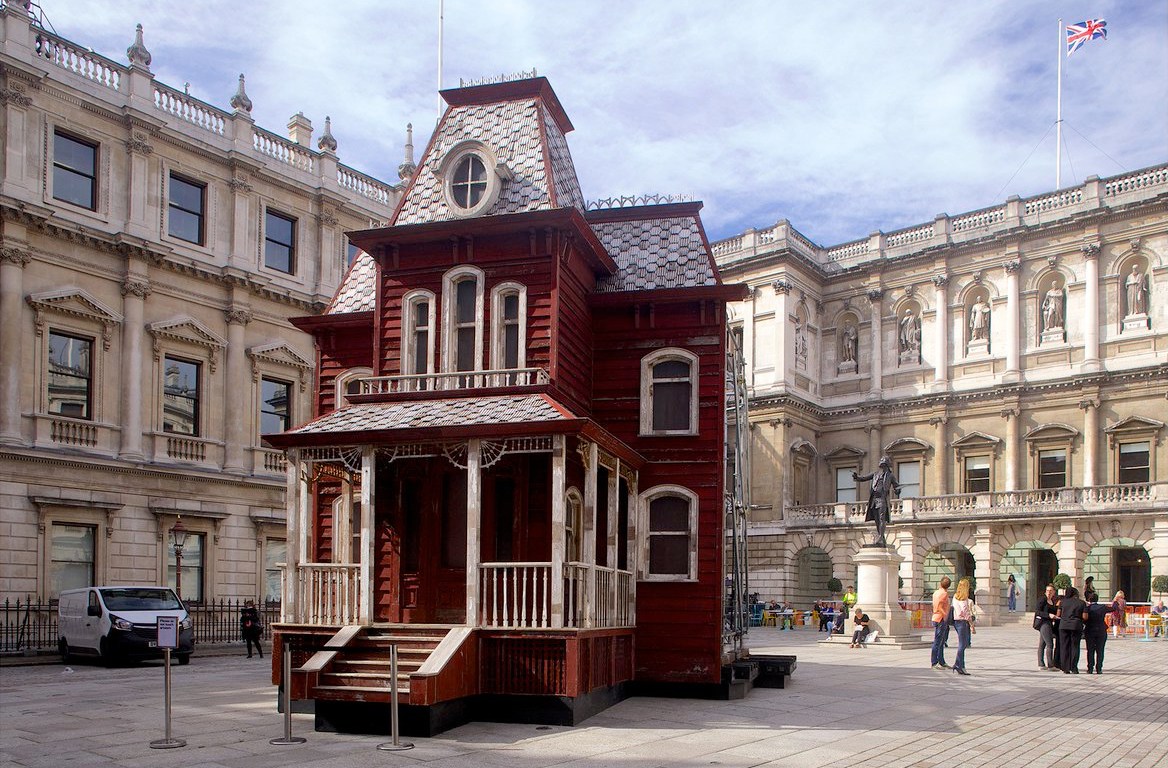
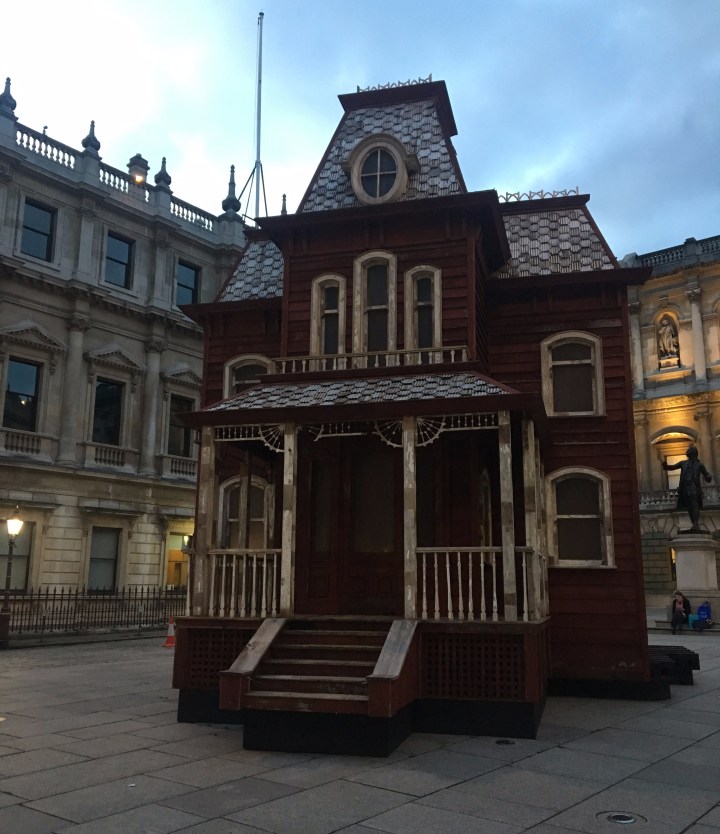
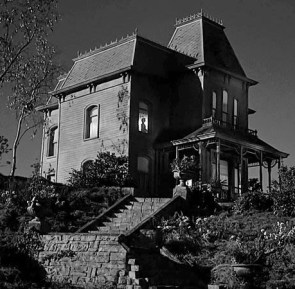
Cornelia Parker’s genius strikes again and this time, in the courtyard of the Burlington House at the Royal Academy of Arts in London. Her installation, Transitional Object (Psychobarn), is a façade held by scaffoldings, reproducing the house built for Hitchcock’s movie Psycho (1960).
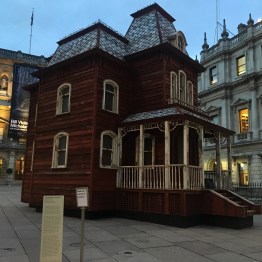 When entering the courtyard, the observer faces what seems to be an entirely built and finished house, from which emanates an inexplicable sense of unease and mystery. He or she stands before a 30 feet tall façade made of red wood and tiles, positioned in the exact same angle as the Bates house in Psycho. Three rows of windows seem to indicate that the house is composed of three floors. These windows are dark and dirty, and seem very damaged, which arouses our curiosity and drives us to what would be the back of the house.
However, when walking around the work, the observer is taken aback by the sight of the scaffoldings, completely unnoticeable from the front. Automatically a question comes to his mind: Why does this building in the midst of its construction look so old and destroyed? The first answer that would come in anyone’s mind is that the construction ended abruptly for unknown reasons. The scaffolding itself seems to have been abandoned some time ago.
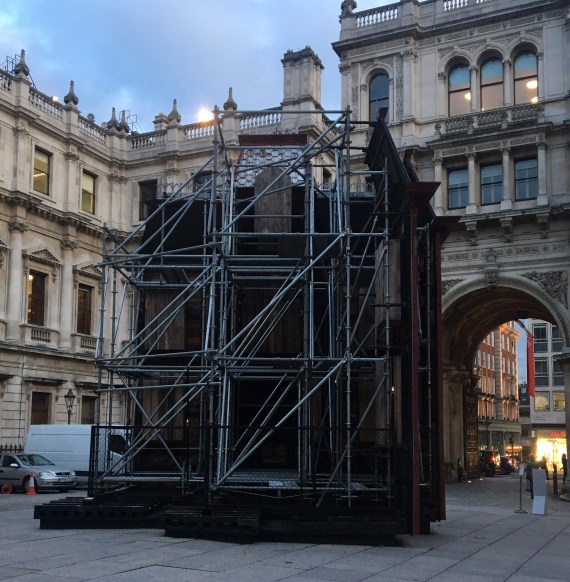
Parker, similarly to many contemporary artists today, presents to us l’envers du décor, what goes on behind the scenes. This house is nothing, but a prop used for a movie. The visitor should’ve noticed from the start that the proportions of the house are much too small for real people to enter!
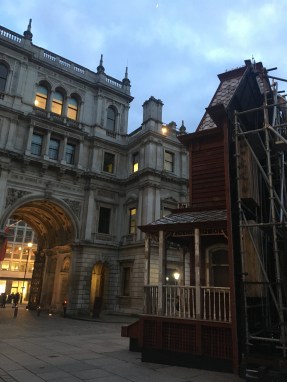 The location of this installation is very interesting: in the middle of a building originally created to host the Academy of the Arts, dedicated to setting rules and principles for artists to follow. The building itself is very polished and traditional, with its courtyard and its façade covered in classical statues. The opposition between the unfinished old prop and the very polished building in which it is exposed is striking and brings forward this very interesting question of the façade, continuously asked by artists nowadays.
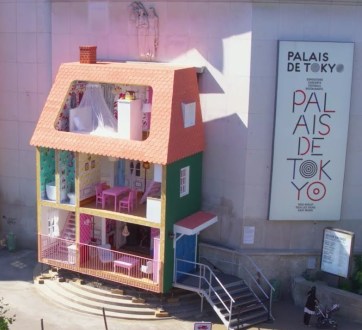
In architecture for instance, artists such as Amabouz Toturo in the Palais de Tokyo in Paris present the inside of the house, putting it on display. Often these constructions aim to decipher of bring to light certain aspect of human psychology. It could first of all refer to our constant need to show certain aspect of our lives to the world reducing us to a façade. However, this work referring to Hitchcock’s movie, it is interesting to associated with the numerous psychological analysis of the made of characters, and particularly Norman Bates. In his interpretation of Parker’s work, Sam Jacob (architect and curator) brings forward Slavoj Žižek’s Freudian interpretation of the Bates house: the ground floor is the id (the instinctive component of our personality), the first floor is the ego (the id modified by the external world) and the top floor is the superego (the id once it has incorporated the moral values which are taught by our peers).
It would be interesting to look at Parker’s work in comparison to this. Here the house is reduced to a façade, there are no real floors. Does this mean that Parker negates entirely Žižek’s and therefore maybe even Freud’s theory? This could lead to unending debates.
Knowing that this installation was originally set in a garden on the roof of the Met museum, one could wonder if it was intended as a revisited folly, very common in Italian private garden and constantly reinterpreted in the 19thand 20thcenturies in the Parc de la Villette in Paris for instance. It’s being placed in a courtyard in the middle of a very busy neighbourhood brings up many questions. Is this work a critique on the constantly evolving world, gradually more and more artificial?
By raising so many questions, most of which remain unanswered, Parker creates a fascinating artwork, and to me one of the great masterpieces of the 21stcentury!
VB
 Artistic Spirit & Co.