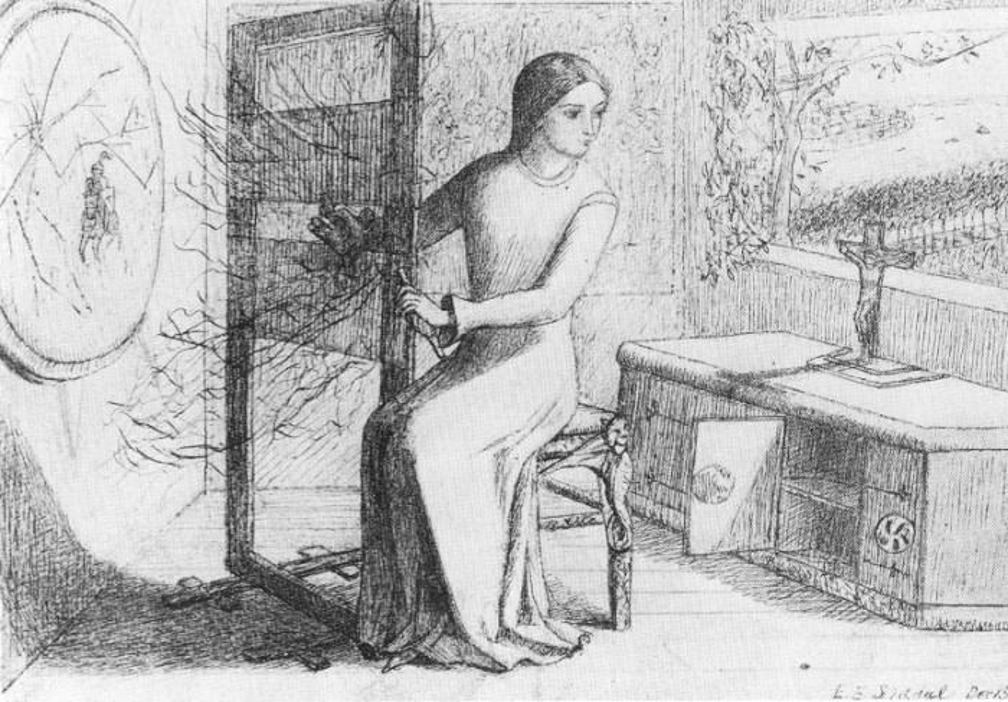
She left the web, she left the loom
She made three paces thro’ the room
She saw the water-flower bloom,
She saw the helmet and the plume,
She look’d down to Camelot.
Out flew the web and floated wide;
The mirror crack’d from side to side;
The poem “Lady of Shalott” (1832) by Alfred, Lord Tennyson (1808-1892) was a source of inspiration for several painters of the Pre-Raphaelite artistic movement. The ballad recounts the life of the Lady of Shalott, a character from the Arthurian Legend. She is the victim of a mysterious curse: she lives alone at the top of a tower, on an island, only able to look at the world through a mirror. One day, she notices the reflection of Sir Lancelot walking at the bottom of the tower, turns around to stare at him, and decides to sail to Camelot, taking with her the tapestry she had woven during her life in captivity. Within a few hours, she is found dead in her boat. For the Pre-Raphaelites, as for Tennyson, the Lady of Shalott was a symbol of the condition of the artist, stuck in the tower of academic conventions, and yet willing to break free, even at the cost of his or her own life. The paintings by William Holman Hunt and John William Waterhouse on this theme are very famous. Yet, although the drawing by Elizabeth Siddal is less striking at first sight, perhaps, it is arguably more profound and powerful as a form of female as well as artistic self-expression. Thus, here, I propose to look at the role Siddal played in the Pre-Raphaelite movement as an artist and as a woman, focusing on her Lady of Shalott.

Another main characteristic of Pre-Raphaelite art lies in the choice of the models used by the painters. The Brothers set strict physical and political criteria and wrote rules regarding the models’ parts in the creative process (1st edition of their review “The Germ”). Most of them were working-class women. Their physical appearance had to be radically opposed to the Victorian canons of beauty. Their hair was very thick, long, red or strawberry blond, and untied. In the 19th century, red hair was regarded as the pinnacle of ugliness. Women also had to tie their hair up, as having your hair down was a sign of carelessness, poverty and lust. The Pre-Raphaelite models’ skin was pale and their bodies tall, slender and curve-less, unlike their wealthy Victorian contemporaries. They were forbidden from using several models to create a feminine figure; this was meant to convey a realistic approach and to avoid any temptation of idealisation in women’s features. Julia Margaret Cameron (1815-1879), one of the first photographers to promote photography as art, portrayed Pre-Raphaelite models and was deeply influenced by the Pre-Raphaelites. Thanks to her magnificent work, we know how these artists and models looked in the flesh. She was a close friend of the Rossetti brothers and accompanied them to the well-known artistic and intellectual evenings of her sister, Sara Prinsep, in Kensington. Unfortunately, there is no known picture of Elizabeth Siddal by Cameron. However, Cameron took pictures of another beautiful muse, Julia Jackson (niece of the photographer, mother of Virginia Woolf), who posed as a model for Edward Burne-Jones’ Annunciation (1876-79, oil on canvas, Tate Britain). The similarity between Cameron’s photographs(taken in 1867 and 1872) and Burne-Jones’ Virgin Mary is noteworthy. It underlines the search for realism that haunted the Brothers. Siddal was the incarnation of the feminine beauty that was so celebrated by the Pre-Raphaelite artists.


The writer Alfred Tennyson was close to the Pre-Raphaelites. His favourite myth was Le Morte d’Arthur, which relates the fictional story of Sir Arthur, King of Camelot. Tennyson dedicated long poems to the most unknown parts of the story. He chose the episode of Lady of Shalott’s death over many others because he found it especially intriguing, as did Pre-Raphaelite members and countless followers after him. Holman Hunt’s Lady of Shalott (1886) illustrates the same verses as Elizabeth Siddal, in a much more symbolic way.

The Lady of Shalott stands in the middle of a richly decorated and furnished room. She melts into the background as her dress is in the same tone as the richly decorated walls. At her feet lie her shoes, her loom and blue bobbins. By comparison, Siddal’s interior is plain and bare. The gate, that symbolizes prison, is central to Hunt’s composition. Unlike Siddal, he did not represent a closed room, but decided to allude to this enclosure by adding this element. The mirror for Holman Hunt has a key role in this myth: it represents the veil of conventions through which society forces people to look at the world. Therefore, he placed it at the centre of the composition. It reflects the bright outside world, in opposition to the darkness into which the scene is plunged. Siddal gave less importance to the mirror, and placed it at the side of the drawing, barely visible. Holman Hunt’s Lady is in motion; the detailed wrinkle and layers of her dress are swaying. Her hair seems to be blown by the wind, creating a great black cloud just over the mirror, just as stated in the poem. Elizabeth Siddal’s drawing is more simplistic. The lady is in a motionless but unnatural position: we can guess that she is about to move, but no movements are represented. There seems to be an evolution in the essence of feminine beauty. On the drawing, the Lady seems to have a pale skin, light coloured hair and eyes, and no curves at all. The model used by Holman Hunt has a very similar style of hair, but brown, and darker eyes; she wears a better-fitted dress that enhances her curves, which are more important here. This comparison highlights the specificities of Siddal’s art. In that period, being both an artist and a woman was extraordinary. Who was she? What kind of life did she lead? Her drawing may help us to answer these questions.
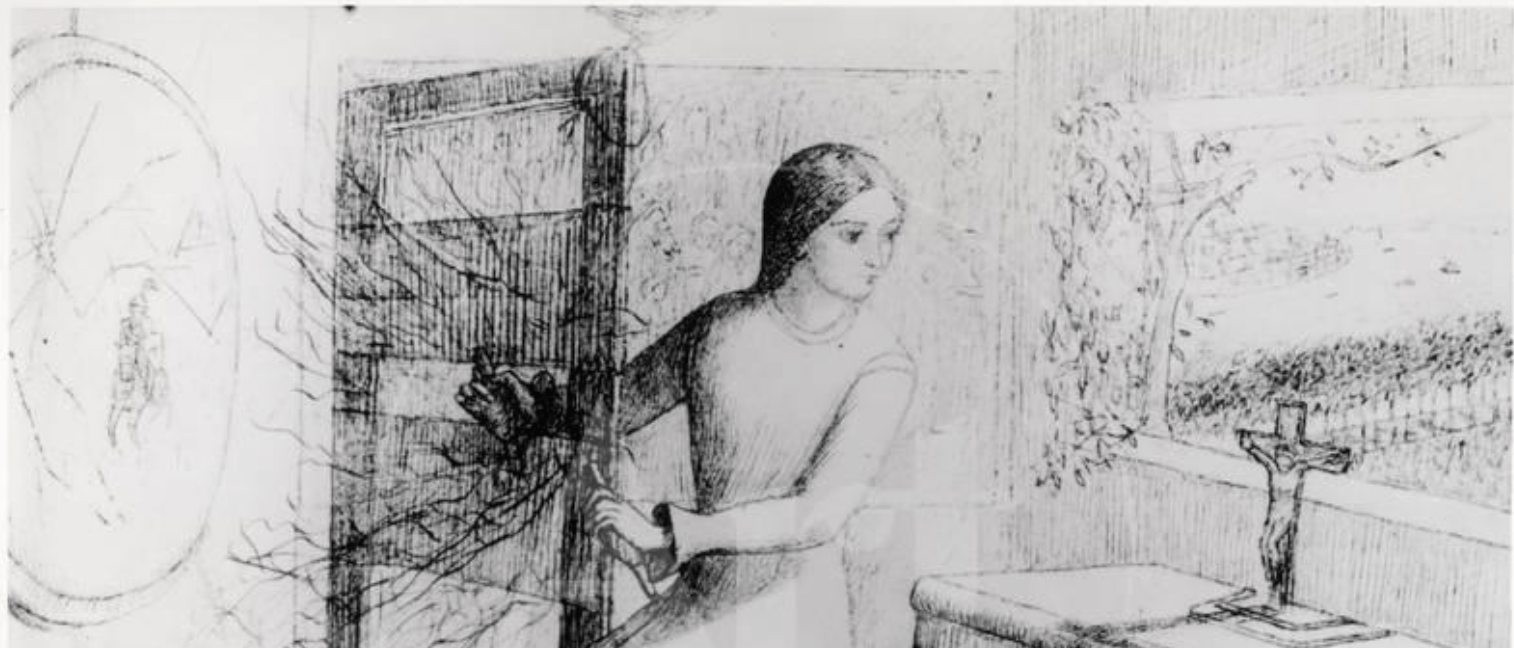
In Elizabeth Siddal’s drawing, the Lady of Shalott sits at the centre, hands on her loom. The character is in movement, her head slightly turned away from the tapestry in a spontaneous gesture. On the left-hand side of the drawing, the mirror through which she sees the world hangs on the wall. It is cracked (as stated in the poem) and carries the reflection of a small knight, Sir Lancelot. The spell has just been broken. To her right we can see a small open sideboard or chest, on which a crucifix stands. Just above, a large window leads the spectator’s eyes to what appears to be the river that flows to Camelot. The composition of this drawing is very typical of the Pre-Raphaelite movement: in the centre is an extremely beautiful woman; the hand of the artist is firm; the lines are precise and sure. The Lady is surrounded by Gothic pieces of furniture (a stool, a chest and a loom), richly carved and precisely depicted. The vegetation in the background is abundant but blurred. This kind of focus is very close to photographic techniques: a neat focus point in the centre of the composition and a blurred background. The trees outside the window are sketched with no intention of precision, as if unfinished. Light and perspective are not as chiselled as the rest of the composition. The shadows are sketched in a rough manner, and do not seem to melt into the drawing in a very convincing way. The volume of the spaces is barely marked off. They are rendered in a rather simplistic and primitive way (a tribute from the Victorian artist to her predecessors, the Italian and Flemish masters of the early Renaissance). The lack of order and Victorian academism is extravagantly highlighted. Pieces of unused thread are bursting out of the loom. Their size and position are very unrealistic, so as to underline the disorder and imperfection of this domestic and intimate scene. The mirror on the wall is hardly visible and the reflection of the knight almost comically small. It reminds the spectator of the narrative aspect of the drawing but also confirms that the legend is not the only topic (although it should be if conventional rules were applied). This drawing is also about feminine beauty and new aesthetic concepts. It is typical of the movement in its celebration of female beauty (it is hard to find a Pre-Raphaelite painting whose main character is not a woman) and the revival of medieval themes (medieval legends, gothic interiors and architecture were also central in Pre-Raphaelite works of art).
It is likely that this representation of the Lady of Shalott is a self-portrait, as the Lady’s features look very similar to those of Elizabeth Siddal herself. We have many drawings and paintings representing the artist, since she modelled for the Pre-Raphaelite painters Deverell, Everett Millais and then exclusively for her lover and later husband Dante Gabriel Rossetti. It is worth comparing the lady in the drawing to two known representations of Siddal: Ophelia ( 1851-52, oil on canvas, Tate Britain collection) by Millais and Elizabeth Siddall Plaiting her Hair (1854, pencil, Tate Britain Collection) by Rossetti.


Millais’ Ophelia illustrates a scene from “Hamlet” by Shakespeare. Millais enrolled Siddal to model as the unfortunate Shakespearian heroine. She was asked to pose in a hot bath wearing a wedding dress. Millais’ scene depicts the moment preceding Ophelia’s suicide. The character occupies the central part of the painting: her whole body is submerged into the water and her face looks up towards heaven, as she sings songs and waits for death. Her long hair is untied and floats around her face. Common points in the faces of the two women are obvious: they have the same thin and pointy nose, small and distinctive lips, long and thin eyebrows. The Lady of Shalott’s hair is also very similar to Ophelia’s hair. The only notable difference lies in their glances: in Ophelia, Siddal’s eyes are drained of expression, as though dead, whereas in The Lady of Shalott, the woman’s eyes are wide open, full of life and curiosity.
Other works, particularly those by Rossetti, also suggest strong similarities between Elizabeth Siddal and the woman in her Lady of Shalott. According to contemporaries, Dante Gabriel Rossetti drew hundreds of portraits of Siddal. The one titled Elizabeth Siddall Plaiting her Hair (1854, pencil, Tate Britain Collection) caught my attention because of the position of Elizabeth. Rossetti chose to portray her in three-quarter profile, just like the Lady in our drawing. Although it is not the same profile (left one in Rossetti’s drawing, right one in Elizabeth Siddal’s), the eyes, staring deeply into something – maybe a mirror in Rossetti’s drawing, and through a window in Siddal’s drawing – are the same. The delicate ovals of the faces, the hands pictured in a gracious gesture, are the same. Both seated, the ladies wear a long, loose, plain dress that highlights their slenderness. In her biography, Lucinda Hawksley describes the clothing style of Siddal as very peculiar for a Victorian woman. Her long floating dresses were soon emulated by all of the Pre-Raphaelite ladies. All in all, close observation of drawings and paintings of that period led me to the conclusion that Elizabeth Siddal’s Lady of Shalott is very likely a self-portrait.
Furthermore, my research led me to think that the resemblance between the two women is more than just physical. Elizabeth Siddal may have been particularly touched by Tennyson’s verses because she saw her life reflected in the medieval legend. The Lady of Shalott was an isolated and lonely woman. She was forbidden any type of contact with the outside world and had to look at it through a mirror. Siddal was also a very isolated and depressed woman. Raised in a modest working-class family, she was “discovered” by the painter Walter Deverell while working as a milliner’s assistant in Leicester Square. Although her new artistic life was highly exciting, Siddal often felt “out of place” and ostracised by Victorian society: modelling was not regarded as a moral activity. In the 19th century respectable women did not work and lived under their husbands’ or fathers’ roof and rules. Siddal also suffered from an unknown disease. Some assume that her symptoms were caused by her addiction to laudanum, a medical mix of opium and alcohol. Addiction to laudanum was very common in the 19th century, and famous figures of the artistic scene were regular consumers: Walter Scott, Wilkie Collins, Coleridge and Elizabeth Barrett Browning (Robert Browning’s wife). Laudanum was also used as a treatment to cure physical and mental diseases, such as depression, which was why Siddal started taking it. All her life she endured frequent nausea, lack of appetite, a continuous nervous cough, sudden bouts of vomiting, breathlessness, dizzy spells and a general feeling of weakness. These strange symptoms would come and go in a very sudden and irregular pattern.
Thanks to Rossetti’s letters, it is clear to her biographers that Siddal’s health was greatly affected by the ups and downs of her unsettled relationship with the painter. Born to Italian parents in London, Rossetti was very attractive but inconstant. Although he was said to be madly in love with Elizabeth Siddal and obsessed with her beauty, he had affairs with other women and muses. Rossetti came from a very traditional Italian family who strongly disapproved of Elizabeth. Siddal’s deep feelings of loneliness have been linked to Rossetti’s lack of commitment, to his resentful mother and sisters, and to his unfaithful behaviour. Like the Lady of Shallot who was forced to look at the image of loving couples in her mirror, Elizabeth was condemned to suffer in silence. The Lady of Shallot was drawn in the early years of their relationship, but it is tempting to see an echo of Siddal’s distress in the reflection of the valiant knight on the broken mirror. In 1860, only two years before her death, Rossetti proposed to her, but marriage did not put an end to the painter’s escapades. She felt abandoned and misunderstood. In 1861, she gave birth to a stillborn child. Her sadness and her physical troubles increased critically. In 1862, she took a laudanum overdose and died.
In conclusion, Elizabeth Siddal fully subscribed to the spirit of the Pre-Raphaelites, and her art displays the features of the movement’s techniques and style. She used a vivid pallet and simplified volume and depth, as evidenced by many of her drawings. Meanwhile, in her personal life, she adopted its aims and in many ways lived like a romantic heroine. Elizabeth Siddal’s drawing also shows her love for poetry, and indeed as a writer she explored the links between painting and poetry. Nonetheless, her artistic skills were not as outstanding as those of Gabriel Rossetti or Edward Burne-Jones and her artistic career was short, lasting a mere ten years. This is probably the reason why she has long been regarded as a minor actor in the Pre-Raphaelite movement. However, her importance as a model and muse, as an artist in a predominantly male artistic community, and as a woman in a patriarchal society, trapped in her time, cannot be denied. For these reasons I would argue that both her art and her life merit further interest and study.
 Artistic Spirit & Co.